Marcel Bouraine: master of Art Deco sculpture
Marcel Bouraine (1886–1948) was a French sculptor, renowned for his elegant Art Deco works. He worked in bronze, ivory, metal d’art and glass, and sometimes signed as Matto, Derenne or Briand. He was a close friend of Max Le Verrier and Pierre Le Faguays, with whom he often collaborated.
His creations – graceful dancers and powerful Amazons – can be admired in museums, on the art market, and of course at Deconamic.
A Marcel Bouraine sculpture remains highly sought after by collectors worldwide.

Who was Marcel Bouraine?
Marcel André Bouraine was born in 1886 in Pontoise, France, and died in 1948 in Biot. During the First World War, he was captured by the Germans and interned in Switzerland. There, he met other artists, including Max Le Verrier, with whom he became lifelong friends.
After the war, he studied and worked in Geneva, rebuilding his career as a sculptor.
Bouraine was largely self-taught but also studied under Jean-Alexandre-Joseph Falguière, a sculptor who brought realism back to French sculpture. Later, he exhibited in Geneva and settled again in Paris, where he took part in major exhibitions.
He shared his life with the artist Aurore Onu.

Friendship with Max Le Verrier
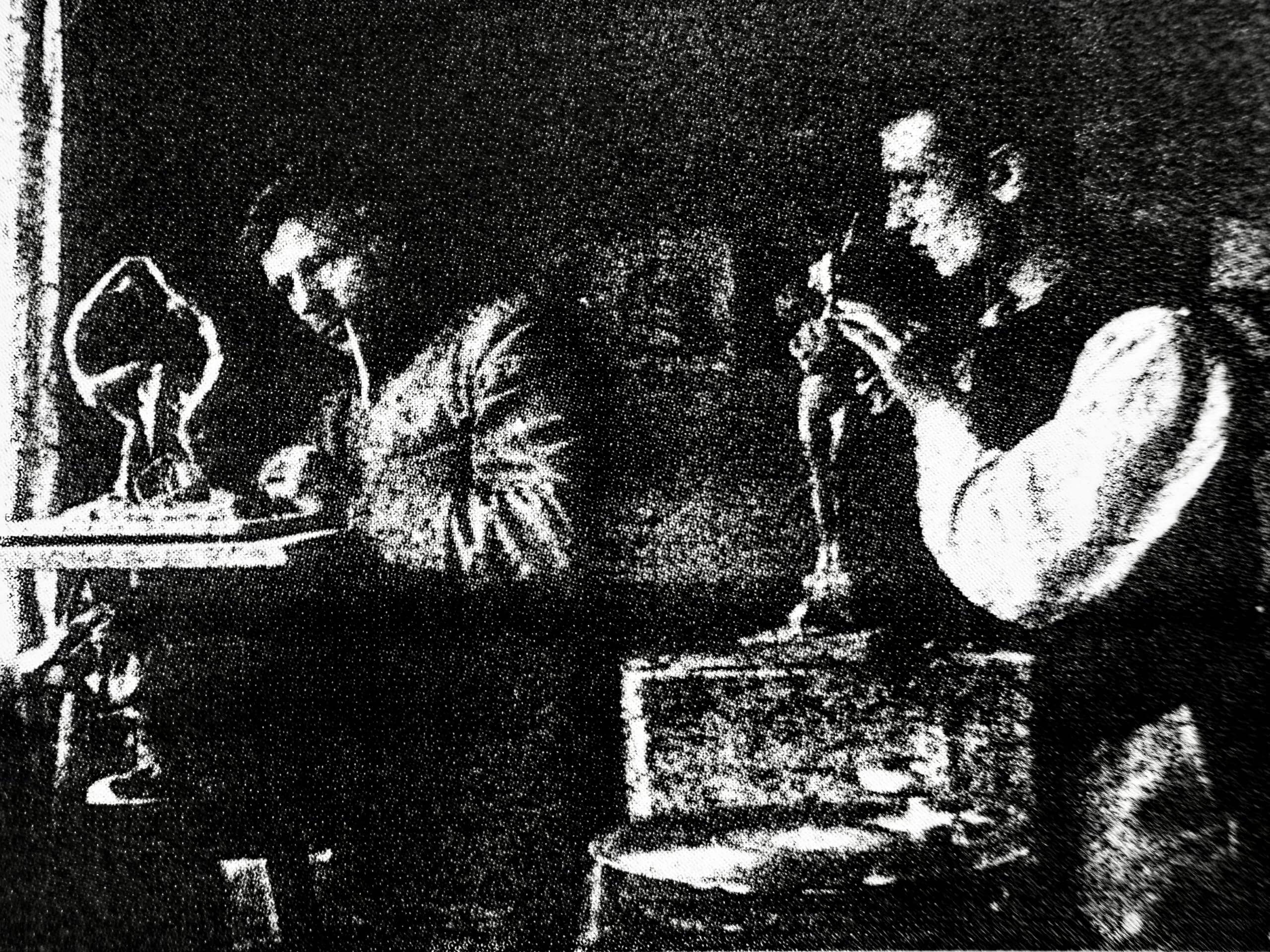
Bouraine was a close friend of Max Le Verrier, another iconic Art Deco artist. Together with Pierre Le Faguays, they formed a strong circle. A photo from Geneva (1918) even shows Bouraine and Le Verrier working on a sculpture side by side. They had both studied at the Geneva School of Fine Arts.
Their collaboration was intense: Bouraine had his works cast in Le Verrier’s foundry and sometimes used his pseudonyms Derenne and Briand. Thanks to this partnership, his sculptures were widely distributed and became accessible to both museums and private collectors.
Style and themes in his sculptures
Bouraine’s art is characterised by stylised female figures, dancers such as the Fan Dancer, and Amazons. He captured movement both elegantly and powerfully, often with a decorative touch.
He also created mythological figures such as Penthesilea Queen of the Amazons, Leda and the Swan, Pan with satyrs, and Diana the Huntress, as well as theatrical characters like Harlequins, Pierrots and clowns.
His oeuvre also included animal figures (whales, birds, marabous, greyhounds, gazelles) and decorative objects such as bookends and paperweights, some of which were even sold in New York through Alfred Dunhill.
His sculptures are typical of the Art Deco style: clean lines, decorative forms and a balance between beauty and strength.
What is Art Deco? Art Deco is an artistic movement from the 1920s–1930s, known for geometric forms, luxury materials and elegant, stylised figures.
 Exhibitions and career
After the First World War, Bouraine built his career in Paris. He exhibited at the Salon des Tuileries (1922/23), the Salon des Indépendants, the Société des Artistes Français and the Salon d’Automne.
In the 1920s, he worked with leading Parisian éditeurs such as Etling et Cie, Susse Frères, Max Le Verrier and Arthur Goldscheider. Through Goldscheider, he also participated in the artist groups La Stèle and L’Évolution.
His international recognition grew quickly: in 1935, the city of Paris purchased a terracotta bust from him, and in 1937 he received prestigious commissions at the Exposition Internationale des Arts et Techniques in Paris. There, he created a monumental coloured cement relief of 12 m² for a fountain, and a large ceramic sculpture for the Sèvres pavilion.
Which materials did Marcel Bouraine use?
Marcel Bouraine worked with a wide range of materials and techniques:
- Bronze: often patinated, gilded or silvered
- Chryselephantine: a combination of bronze and ivory
- Pâte de verre: powdered glass melted in a mould to form a sculpture
- Terracotta and ceramics: including busts and decorative pieces
- Marble and onyx: for certain sculptures and for the bases of bronzes
His broad use of materials demonstrates both his versatility and his collaborations with various ateliers. His partnership with Gabriel Argy-Rousseau, for example, led to remarkable glass art pieces such as the Danseuse (1928).

The power of his bronze sculptures
The bronze sculptures of Marcel Bouraine are among his most admired works. He often used the lost-wax technique (cire perdue), a traditional casting method where a sculpture is first modelled in wax and then cast in bronze. This process allowed every fine detail of movement, muscle and expression to be captured perfectly.
Bouraine chose elegant patinas – green, brown, silver or golden tones – that gave his works an extra vibrancy. His bronze dancers, Amazons and mythological figures remain iconic examples of the Art Deco style and are still collected worldwide.
Where were Bouraine’s works produced?
Bouraine collaborated with several ateliers and foundries:
- Max Le Verrier: bronze, spelter and metal d’art, often under the pseudonyms Briand or Derenne
- Susse Frères: a prestigious Parisian bronze foundry
- Etling, Paris: producer of sculptures in bronze, ivory and ceramics
- Arthur Goldscheider: known for bronze, terracotta and ceramic editions
- Gabriel Argy-Rousseau: collaboration in glass (pâte de verre)
These collaborations made Bouraine one of the most prolific sculptors of his generation.

Famous works by Marcel Bouraine
Some of his best-known sculptures include:
- Fan Dancer (nude dancer with fan)
- Danse Païenne, signed Derenne
- Penthesilea, Queen of the Amazons – in Norwich Castle Museum
- Dancing Woman with Hoop – in the Art Institute of Chicago
- Various female nudes in bronze and ivory – exhibited in Paris during the 1920s and 1930s
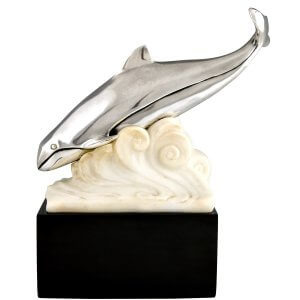
At Deconamic, you can regularly find authentic works, such as a bronze dancer on a marble base or a graceful whale in bronze and alabaster.
Frequently asked questions about Marcel Bouraine
What makes a Marcel Bouraine sculpture special?
A Marcel Bouraine sculpture stands out for its elegant movement, Art Deco style and refined materials. Each piece is both a work of art and a decorative object.
Is an original Marcel Bouraine better than a reproduction?
Yes. Original bronzes are signed, often bear a foundry stamp, and are far more valuable than later reproductions.
|
Comparison |
Original |
Reproduction |
|
Value |
High, collectible |
Lower |
|
Material |
Bronze, Art Metal, marble |
Often spelter or cheap metal |
|
Authenticity |
Signed, often stamped |
Not signed |
What is the price range of a Marcel Bouraine artwork?
Smaller bronzes or patinated metal works by Bouraine usually sell for €1,000–€5,500. Larger or special pieces, such as chryselephantine sculptures (bronze and ivory), fetch considerably more.
Why buy a Bouraine from Deconamic?
At Deconamic, you are assured of authenticity, provenance and quality. We work directly with recognised experts and offer Art Deco masterpieces by artists such as Marcel Bouraine, Pierre Le Faguays and Max Le Verrier.
Discover our collection of Marcel Bouraine sculptures and find unique Art Deco pieces for your home or collection.
Questions? Feel free to contact us – we are happy to help.
