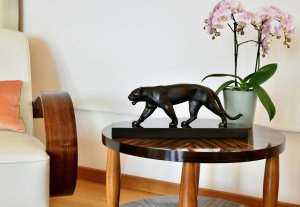
Art Deco panther sculpture
Why an Art Deco Panther Is Never Just a Sculpture
Place an Art Deco panther in a room and people keep looking. Not just for a moment, but really looking. As if something is happening that they cannot explain straight away. That feeling is no coincidence.
Behind that streamlined shape lies a whole story of power, luxury and historical perfection. And that is exactly why these bronze sculptures still have such a strong effect in an interior today.
Why the panther in Art Deco?
Why a panther, of all animals? There are plenty to choose from. But no other animal fits the Art Deco idiom so perfectly.
A panther is naturally streamlined, almost geometric. That muscular body, that low stance, that controlled power. It is as if the sculpture could move at any moment. Artists such as Maurice Prost only had to reduce that form to its essence. What remains is pure. And powerful.
There is symbolism too. In the 1920s and 1930s, the panther stood for luxury, speed and a latent tension beneath the surface. Not aggressive, but never fully calm either. That edge is what makes it so interesting.
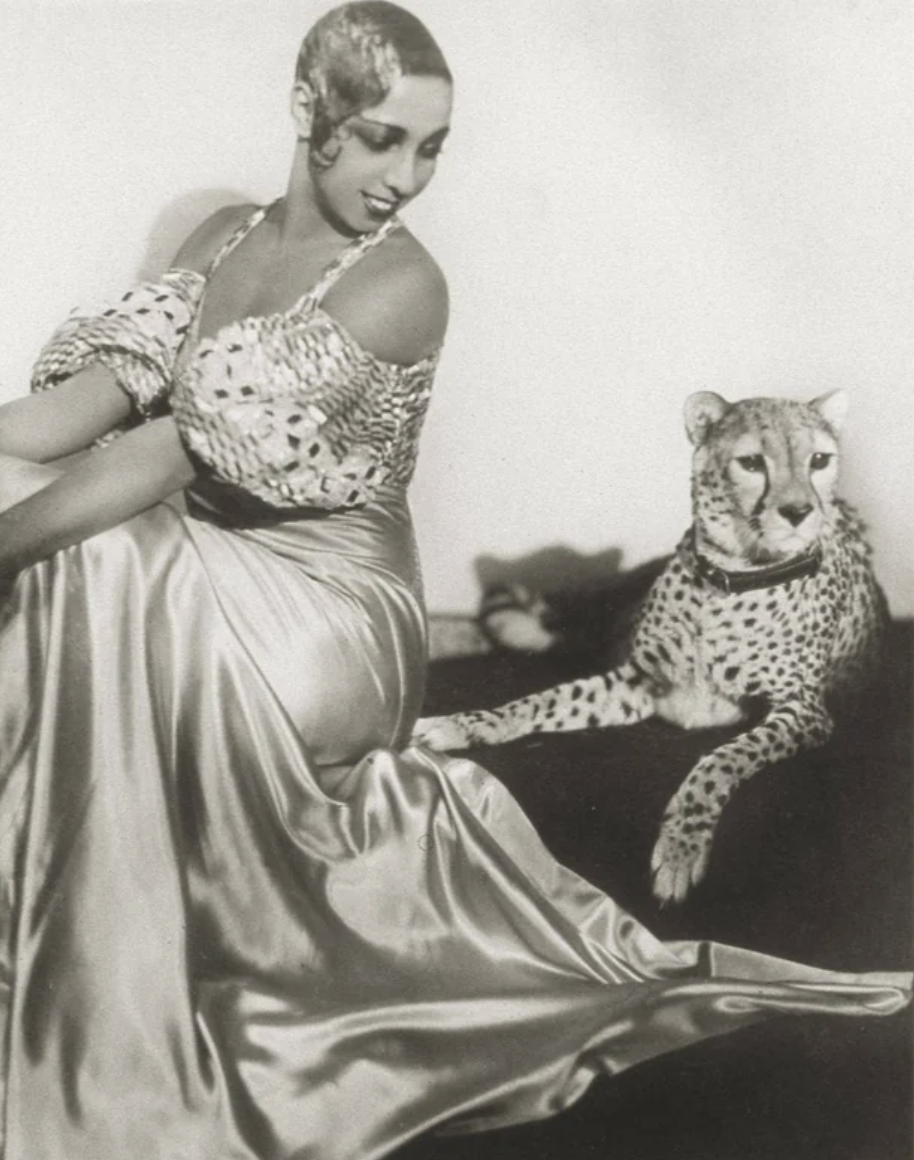
And then there is the fascination with the exotic. During the Art Deco period, people dreamed of faraway places and adventure. The discovery of Tutankhamun’s tomb in 1922 only fueled that fascination. Joséphine Baker walked across the Paris stage with a tame cheetah named Chiquita wearing a diamond collar. Suddenly, that world of mystery and symbolism entered the living room, and the bronze panther almost naturally became part of it.
Our favourite Art Deco panther sculptures
Each artist approaches the panther in a slightly different way. It is the same animal every time, yet the feeling shifts with each interpretation. Here is an overview of our favourites.
Maurice Prost – His walking panther from 1927 is the essence of the Art Deco panther sculpture. Clean lines and a clear sense of movement, with the slanted base in Belgian black marble making the whole composition even more dynamic. It is no coincidence that Deconamic chose this model as its logo.
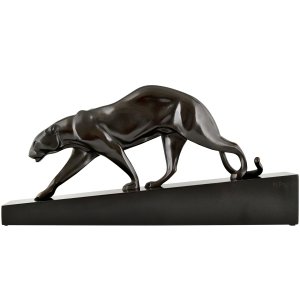
Max Le Verrier – Models such as Baghera and Ouganda are slightly softer, yet still immensely powerful. Always executed in patinated metal, always on black marble. Typical Art Deco: streamlined, with the emphasis on silhouette and muscle line. Our bestsellers.
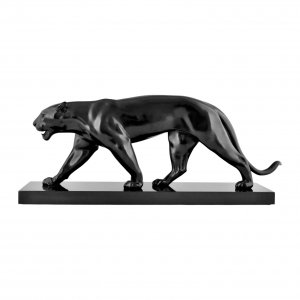
Georges Lavroff – He opts for more drama. His stalking panther with its jaws open radiates pure intensity. So impressive that this model appears on the cover of the book devoted to Lavroff himself.
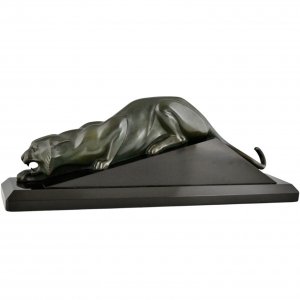 Irenée Rochard – He takes a different route. His bronze pair of panthers conveys tenderness rather than threat. A rare variation in a genre that usually focuses on power.
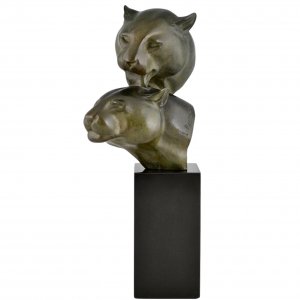 Michel Decoux – His stylised panthers in patinated bronze, mounted on an elegant marble base, combine refinement with Art Deco precision. A documented work that returns in specialist literature.
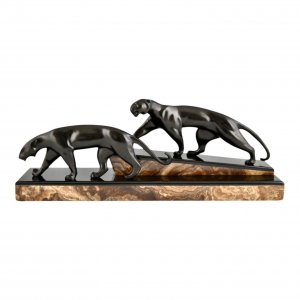 André Vincent Becquerel – A stalking panther in patinated bronze, cast by the renowned Susse Frères using the lost-wax process. A masterly execution that found its way into the standard works on animal sculpture.
“The powerful shape, the graceful gait, the tension beneath the surface. You do not need to explain it to someone who feels it. They simply understand” – Marjolein, Deconamic
Where does an Art Deco panther fit in your interior?
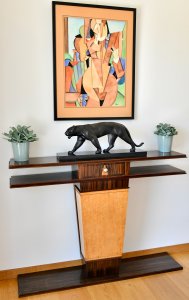 An Art Deco panther works in surprisingly many interiors. The real question is not whether it fits, but where you want to place the accent.
In a modern interior, a bronze panther creates the perfect contrast.
In a classic room, it blends in seamlessly.
And in an eclectic interior, it is the wink to the past that ties everything together.
Scale matters too. A larger model on a mantelpiece, sideboard or console table instantly becomes a statement. A smaller sculpture on a desk or in a bookcase is more subtle, but carries that same sense of presence.
Do you already have a specific style at home? Or are you looking for that one piece that sets the tone? In our collection you will find both understated and expressive models, in bronze, art metal and marble.
And there is another argument that increasingly makes the difference: “Antiques are green.” A bronze sculpture that has existed for a hundred years needs no new raw materials. A collectible sculpture can be passed on to the next generation. Sustainability with character.
Buying an Art Deco panther: what is the budget?
Buying an Art Deco panther is a very deliberate choice for many people. We sell around 30 to 40 each year. That says a lot in itself. People search for them with purpose, because they know what such a piece adds to their interior.
Deconamic’s collection ranges from €950 to €14,500, with the largest selection between €1,500 and €3,800. Depending on the artist, size and material, you will always find a piece that fits both what you are looking for and what you want to spend.
👉 View the full range of Art Deco panthers at Deconamic.com
Frequently asked questions about Art Deco panthers
Why are Art Deco panthers so popular?
Because they bring together the perfect mix of strict geometric form and emotion. They radiate power, luxury and elegance, which is why they work in many different interiors.
What type of interior suits an Art Deco panther?
Modern, classic and eclectic interiors can all work beautifully. That versatility is exactly what makes these sculptures so timeless.
Where should you place an Art Deco panther?
Larger models look impressive on a mantelpiece, sideboard or console table. Smaller sculptures fit perfectly on a desk, coffee table or in a bookcase.
Is an Art Deco panther a sustainable choice?
Absolutely. A bronze sculpture that has already existed for a hundred years needs no new raw materials. You are choosing something that lasts, both in style and in value.
How much does an Art Deco panther sculpture cost?
Prices range from €950 to €14,500, depending on size, artist and material. The largest selection sits between €1,500 and €3,800.
Looking for the right sculpture?
 After reading all this, you may look at an Art Deco panther a little differently. Not just as a beautiful object, but as something in which form, history and emotion come together.
Whatever your interior style and whatever size you are looking for, there is always a panther that fits. Browse the collection and discover which sculpture catches your eye.
👉 View the full Art Deco panther collection at Deconamic.com